Getting Started
How to Get Started with Your First AI Employee: A Step-by-Step Guide for Singapore SMEs
A step-by-step guide for Singapore SMEs to identify workflows, audit opportunities, build an AI employee, test it, and go live.
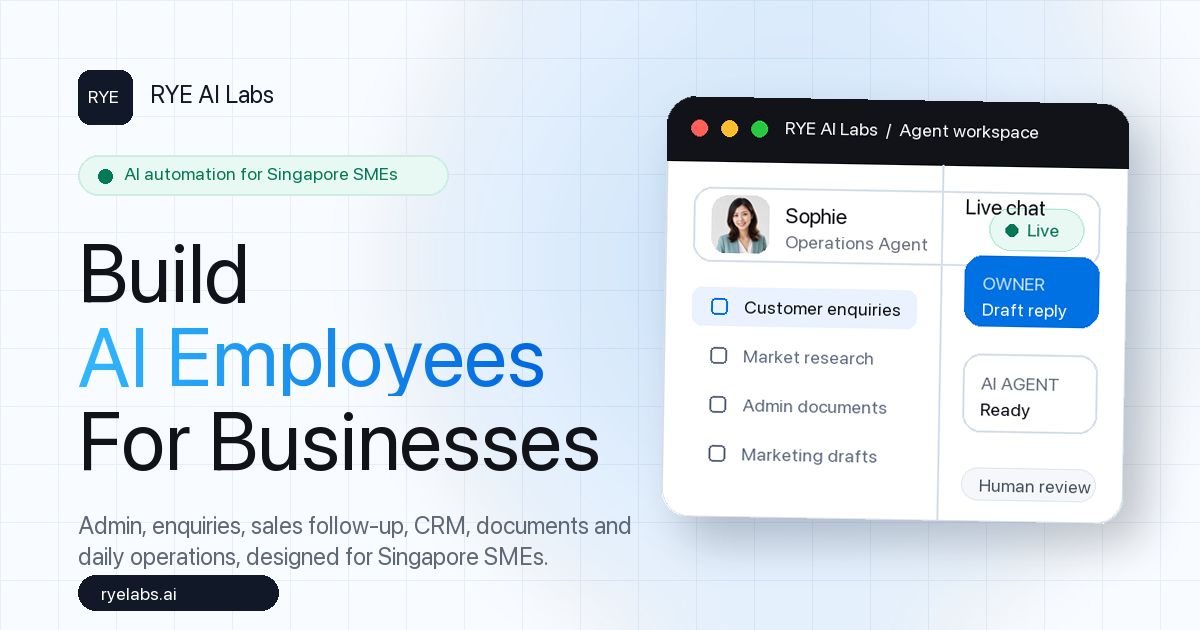
You've read about AI employees. You've seen the cost comparisons and the ROI calculations. Now you're ready to take the first step — but what does getting started actually look like?
This guide walks you through the entire process, from identifying your first workflow to having a working AI employee handling real tasks in your business.
Step 1: Identify Your Most Painful Repetitive Workflow
Before you talk to any vendor or try any tool, you need clarity on what you want to automate. The best first AI employee targets one specific, repetitive workflow that eats the most owner or staff time.
How to find it:
Track your time for one week. Note every task you repeat more than 3 times. Common candidates for Singapore SMEs:
- Answering customer questions on WhatsApp or email
- Following up on unpaid invoices
- Updating spreadsheets with order or shipment data
- Drafting social media posts or newsletters
- Scheduling appointments and sending reminders
- Generating quotation or proposal documents
Pick the one that costs you the most time or the most lost revenue. For most small businesses, it's either customer enquiries or sales follow-up.
Step 2: Map Your Current Process
Before an AI employee can handle a workflow, you need to document how it currently works. This doesn't need to be complicated — a simple outline is enough.
Example: Customer enquiry workflow
- Customer sends WhatsApp message
- Owner reads message (usually during lunch or after hours)
- Owner checks FAQ or internal docs for answer
- Owner types reply
- If complex, owner asks for more info or escalates
- Owner logs the enquiry (maybe)
What to capture:
- Where do messages come in? (WhatsApp, email, web form, social media)
- What types of questions repeat? (pricing, availability, status, returns)
- What information do you need to answer? (product catalog, policies, account data)
- When do you typically respond? (immediately, batched, next morning)
- What happens with complex or urgent cases?
This map becomes the blueprint for your AI employee's workflow.
Step 3: Assess Your Tool Stack
List the tools your business already uses. Most Singapore SMEs have a surprisingly useful set of tools that AI can connect to:
| Tool Type | Common Examples | AI Can Connect? |
|-----------|----------------|-----------------|
| Messaging | WhatsApp Business, Telegram | Yes |
| Email | Gmail, Outlook | Yes |
| CRM | HubSpot, Zoho, Google Sheets | Yes |
| Accounting | Xero, QuickBooks, Wave | Yes |
| E-commerce | Shopify, WooCommerce | Yes |
| Documents | Google Drive, Notion | Yes |
| Scheduling | Google Calendar, Calendly | Yes |
You don't need new software. A good AI employee works with what you already have.
Step 4: Get an AI Employee Audit
An AI Employee Audit is a structured assessment that identifies exactly where AI can help in your business and what the ROI looks like.
What a good audit covers:
- Workflow analysis — Which processes are best suited for AI
- Tool assessment — What integrations are needed
- Volume and complexity scoring — How much time can be saved
- ROI estimate — Expected cost savings vs. investment
- Recommended approach — Which AI employee role to start with
Red flags when choosing an audit provider:
- They promise to "automate everything" (too vague)
- They push expensive enterprise tools you don't need
- They can't show you a concrete example of a working AI employee
- They want a long-term contract before any work starts
Good signs:
- They focus on one workflow first
- They ask about your current tools before recommending new ones
- They show you how the AI employee handles real cases
- They offer month-to-month pricing
Step 5: Start with One Workflow, One AI Employee
The biggest mistake businesses make is trying to automate too much at once. Start with one AI employee handling one workflow.
Why one workflow first:
- You can measure results clearly
- Your team learns how to work with AI
- You build confidence before expanding
- Failures are contained and fixable
What a first AI employee typically handles:
| Role | First Workflow | Expected Result |
|------|---------------|-----------------|
| Customer Enquiry Assistant | Answer FAQ questions via WhatsApp/email | 70-80% of enquiries handled automatically |
| Sales Follow-Up Assistant | Track and follow up on leads | Zero missed follow-ups |
| Admin Assistant | Chase overdue invoices | 50-70% reduction in chasing time |
| Marketing Assistant | Draft social media posts | 2-3 posts per week, consistent |
Step 6: Build, Test, and Train
Once you've chosen your first AI employee, the build process typically takes 2-3 weeks:
Week 1: Build and Integration
- AI vendor maps your workflow in detail
- AI employee is configured with your business rules
- Integrations with your tools are set up
- Knowledge base is loaded (FAQs, policies, product info)
Week 2: Testing with Real Cases
- AI employee handles real enquiries or tasks
- You review every output
- Corrections and adjustments are made
- Edge cases are identified and handled
Week 3: Handover and Training
- You learn how to work with the AI employee
- Boundaries are set (what AI handles vs. what needs human review)
- Monitoring and reporting are set up
- Go-live
Key testing rule: Test with at least 10-20 real cases before going live. Not synthetic test data — actual messages, actual invoices, actual enquiries.
Step 7: Monitor and Optimize
Your AI employee isn't finished on launch day. Like any new team member, it needs monitoring and feedback in the first few weeks.
What to monitor:
- Accuracy rate — Is the AI getting things right?
- Response time — How fast is it handling tasks?
- Exception rate — How often does it need human help?
- Customer feedback — Are customers happy with AI responses?
Monthly review questions:
- How much time is the AI employee saving?
- What's the accuracy rate?
- What new workflows could be added?
- Is the monthly retainer delivering positive ROI?
What to Expect: Realistic Timeline
| Milestone | Timeline |
|-----------|----------|
| Identify workflow + get audit | Week 1 |
| AI employee built and integrated | Week 2-3 |
| Testing and refinement | Week 3-4 |
| Go-live | Week 4 |
| Optimized and stable | Week 6-8 |
| Ready for second AI employee | Month 3+ |
Common First-Timer Concerns
"What if the AI makes mistakes?"
All AI outputs are designed for human review before action. You set the boundaries — AI drafts, you approve.
"Will my customers know it's AI?"
That's your choice. Some businesses use AI transparently. Others use AI to draft responses that the owner sends personally.
"What if it doesn't work for my business?"
Start with a low-risk package. Month-to-month pricing means you can stop anytime.
"How much technical knowledge do I need?"
None. You know your business — that's what matters. The vendor handles the technical setup.
The Bottom Line
Getting started with your first AI employee is simpler than most business owners expect. The key is:
- Pick one painful, repetitive workflow
- Map how it works today
- Get a focused audit (not a sales pitch)
- Build one AI employee for one workflow
- Test with real cases
- Go live and optimize
The businesses that benefit most from AI aren't the ones with the biggest budgets. They're the ones that start small, measure results, and expand from there.
Ready to find out which workflow in your business is best suited for an AI employee? Book a free AI Employee Audit with RYE AI Labs. We'll identify the one workflow where AI can save you the most time — with a clear ROI estimate and zero obligation. Book Your Free AI Employee Audit →
Ready to put this into practice?
Book an AI Workflow Audit. We'll identify the one workflow where automation can save the most time and create the clearest first implementation scope.
WhatsApp Us